Pre Marriage Counseling Questions
You Can Work Through Together
Some couples work through these questions with a professional. Others sit on their own couch, block off a few evenings, and do it themselves. Both approaches work. What doesn't work is skipping the hard questions entirely and hoping love will sort it out.
Researchers at the University of Denver found that couples who did some form of premarital education reduced their risk of divorce by 31%. Not because someone gave them magic words — because they asked each other the real questions before the wedding instead of after the first crisis.
Here are the questions that matter most, organized by topic. Set ground rules before you start: no phones, no interrupting, and it's okay to say “I need to think about that one” instead of forcing an answer. Some of these will be easy. The ones that aren't are the ones you need most.
Money (The #1 Predictor of Marital Conflict)
A Kansas State University study found that arguments about money predict divorce more reliably than arguments about kids, sex, or in-laws. Money disagreements tend to be longer, more intense, and harder to recover from. Get into specifics now.
What's your total financial picture right now?
Income, savings, and debt — all of it. Get specific before you get married.
Do you see money as security, freedom, or something else?
The meaning behind money matters more than the amount. Hard to budget together when you're working from different emotional frameworks.
Are you a spender or a saver — and what happens when those styles collide?
Because they will. Knowing this ahead of time is half the solution.
Joint accounts, separate, or a hybrid? Why?
There's no universally right answer — but there is a wrong one, which is not deciding until it becomes a fight.
What's your "I need to check with you before spending this" number?
Set it now, revisit it as life changes. Misalignment here causes more fights than the actual spending.
What would you do if one of you lost your job tomorrow?
Not hypothetically — what's the actual plan? How many months of runway do you have?
How You'll Fight
Every couple fights. John Gottman can watch a couple argue for 15 minutes and predict with over 90% accuracy whether they'll still be married six years later. What he watches for isn't whether they fight — it's how. He calls the four worst patterns “The Four Horsemen”: criticism, contempt, defensiveness, and stonewalling.
When you're upset, do you attack your partner's character ("you always...") or describe the specific behavior that bothered you?
What does your partner do during an argument that makes you want to leave the room?
Do you fight to win or fight to understand?
When your partner raises a complaint, is your first instinct to explain why you're not wrong?
Do you shut down and leave — physically or emotionally — when things get heated?
When's the last time you apologized and genuinely meant it — no "but" attached?
What's a topic you avoid bringing up because you're afraid of the reaction?
Kids (Beyond "Someday")
This conversation has more landmines than any other. Go slow. Don't let “we'll figure it out when we get there” be the answer — that's not a plan, it's a postponement.
Do you want children? How many? By when?
If it takes longer than expected, how far are you willing to go? IVF? Adoption? Accepting a different plan?
Who stays home — if anyone?
How were you each disciplined growing up, and what would you keep or throw out?
How do you split the invisible work — nighttime feedings, school pickups, doctor appointments, birthday planning?
What if one of you changes your mind about wanting kids after the wedding?
Family and In-Laws
How often do you expect to see each other's families?
If your parents criticize your partner, whose side do you take?
How will you handle holidays when both families expect you there?
Are there family traditions that are non-negotiable for either of you?
Is there a family member either of you has a complicated relationship with — and does your partner know the full story?
Intimacy (Yes, You Have to Talk About It)
Research shows that sexual satisfaction in the first year of marriage predicts relationship satisfaction for years afterward. Yet most couples avoid the specifics.
How important is sex to you — and how important do you think it is to your partner?
What happens when one person wants intimacy and the other doesn't?
Are there boundaries, preferences, or experiences you haven't shared?
What does emotional intimacy look like to you outside the bedroom?
How do you each define infidelity — including emotional and digital?
Values and the Dealbreaker Question
What does a good marriage look like to you? Who modeled that?
Your default template for marriage came from somewhere. Know where.
Where do you want to be in 10 years — geographically, financially, professionally?
If one of you pictures city life and the other has always planned to move back home, this needs a conversation before the wedding.
What role does faith, religion, or spirituality play — and what happens if that changes for one of you?
This one blindsides more couples than almost anything else on this list.
Under what circumstances would you consider divorce?
The hardest question on this page. Also the most useful. Couples who can answer it honestly tend to be more committed, not less — because they've drawn a clear line and chosen to stay on their side of it.
Making This Work at Home
You don't need to cover everything in one night. Spread these across several weeks. Some of the best pre-marriage work happens in ordinary moments — driving home, cooking dinner, lying in bed before sleep.
Pick 3–5 questions per sitting
Don't barrel through the whole list. Give each question room to breathe. The goal isn't to finish — it's to actually talk.
Take turns
One person answers fully before the other responds. No rebuttals, no defending. Just listening, then sharing your own answer.
Write down the surprises
When your partner says something you didn't expect, jot it down. Come back to it later. The gaps in your assumptions are where the real work lives.
Resources Worth Having
If these conversations keep going sideways, or you want more structure, these are worth your time.
BetterHelp
If any of these conversations keep looping back to the same wall, a licensed therapist trained in evidence-based methods (like the Gottman approach) can help you get unstuck. BetterHelp matches you with a therapist within days — sessions happen from your couch, not a waiting room.
Eight Dates — John & Julie Gottman
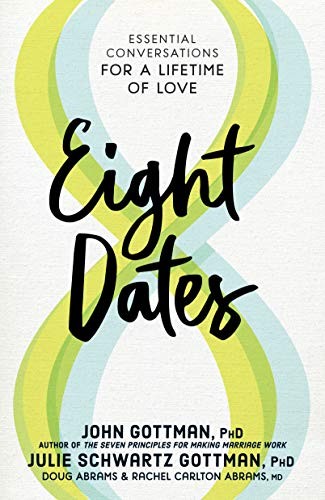
Structured date-night conversations on money, sex, trust, family, adventure, and more. What makes it work: they start with the story behind each topic before touching the practical question. Hard to argue about a spreadsheet when you understand where your partner's relationship with money came from.

The 5 Love Languages — Gary Chapman
Useful for the intimacy conversations because it separates physical touch from the four other ways people express and receive love. If your partner's primary language is acts of service and you keep trying to connect through touch, you're speaking French to someone who only hears Spanish. Reading it together before the wedding saves years of feeling unappreciated for the wrong reasons.
The Goal Isn't to Agree on Everything
It's to know exactly what you're each signing up for. The couples who ask these questions before the wedding don't avoid hard times — they just aren't blindsided when hard times show up.