Does Marriage Counseling Work? What the Research Actually Says
Yes — for about 70% of couples who commit to the process, marriage counseling leads to real improvement. That number comes from the Journal of Marital and Family Therapy, one of the most-cited sources in the field.
But if you're asking this question, you probably want more than a percentage. Here's what the data actually shows — and what it doesn't.
The Key Statistics
The American Association of Marriage and Family Therapists reports that after counseling:
of clients report improved emotional health
report higher satisfaction in their relationship
report improvement in overall physical health
Success Rates by Method
Not all couples therapy is the same. The approach your therapist uses matters:
| Method | Success Rate | What It Focuses On |
|---|---|---|
| Emotionally Focused Therapy (EFT) | 70–73% recovery, 90% show improvement | Attachment and emotional bonding |
| Gottman Method | ~75% | Communication patterns, friendship, conflict |
| Cognitive Behavioral Couples Therapy | ~65% | Thought patterns and behaviors |
| General couples counseling | ~50–60% | Varies by therapist |
EFT has the strongest research behind it. A meta-analysis of 16 studies found it outperformed other methods at reducing relationship distress, with an effect size larger than any other couples intervention measured. The Gottman Method, built on 40+ years of research, is a close second.
Why People Think It Doesn't Work
Three reasons most couples who try counseling feel like it failed:
They waited too long
The average couple waits 6 years after problems start before seeking help. By then, resentment has hardened and patterns are deeply set. Counseling works better when you go earlier — even before things feel "bad enough."
The therapist wasn't a good fit
A bad match is the single biggest predictor of dropout. If your first therapist doesn't click, that doesn't mean counseling failed. It means you need a different therapist.
Only one partner was engaged
Counseling requires both people to participate. If one person shows up with arms crossed and treats it like a box to check, the odds drop fast.
What Predicts Success
Research points to a few factors that matter more than which platform or therapist you pick:
- Both partners willing to try — even reluctantly
- Going sooner rather than later — don't wait until you're one foot out the door
- Doing the work between sessions — counseling is one hour a week; the other 167 hours are on you
- Finding a good therapist match — switch if it's not clicking after 3–4 sessions
How to Get Started
Online platforms like OurRitual and Talkspace can match you with a vetted expert quickly. Online sessions cost roughly $60–110 per week — about half what in-person runs. The barrier to starting has never been lower. The bigger risk is waiting another year.
OurRitual
OurRitual combines expert guidance with personalized digital tools — 300+ vetted therapists, flexible scheduling, and science-backed exercises between sessions. $720 per 12 weeks (3-month plan) or $310 per 4 weeks.
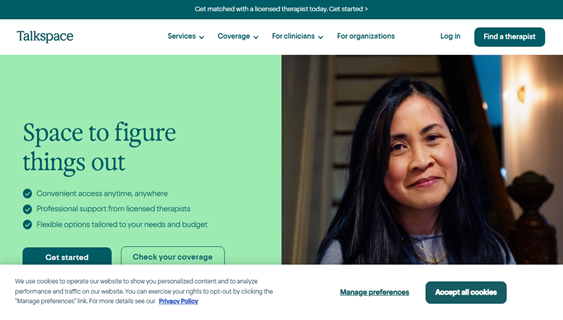
Talkspace
Accepts Aetna, Cigna, BCBS, Anthem, Optum, and TRICARE — your insurance might cover couples sessions, dropping costs significantly.
FAQ
How long does marriage counseling take to work?
Most couples notice a shift within 8–12 sessions. Some issues resolve faster, others take longer. The biggest factor is how engaged both partners are.
What's the success rate of marriage counseling?
About 70% of couples who complete counseling report significant improvement. That number goes up to 73–75% with research-backed methods like EFT or the Gottman Method.
Does marriage counseling work if only one person wants to go?
It's harder, but individual therapy can still help. Sometimes when one partner starts making changes, the other notices and becomes open to joining.
Is online marriage counseling as effective as in-person?
Research conducted during and after COVID confirms that video-based couples therapy produces outcomes comparable to in-person treatment across major therapy models.
When is it too late for marriage counseling?
There's no clinical cutoff, but earlier is better. If both partners are still willing to sit in the same room (or on the same video call), it's not too late.